Why Smart Investors Are Moving from 3BHKs to Studio Apartments
The old playbook of buying a large apartment and waiting for appreciation is fading. Today's investor is asking a sharper question: how does this asset actually perform?

Key Takeaways
- A ₹1–2 crore apartment typically yields just 2–4% a year, with capital locked in a single, slow-to-sell asset.
- Studios cost ₹40–60 lakh, deliver higher rent per square foot, and sell faster to a much wider buyer pool.
- Smaller tickets let you diversify across multiple income-generating assets instead of over-committing to one.
- Studios only work when location, real demand, and a credible operator all line up — otherwise it is just a smaller mistake.
Twenty years ago, real estate investing in India meant one thing: buy a 2BHK or 3BHK, hold it for a decade, and wait for appreciation to do the heavy lifting. For an entire generation, that playbook worked well enough that nobody questioned it.
It is fading fast. Today's investor has watched large apartments tie up huge amounts of capital while producing thin, unremarkable rents — and is now asking a far sharper question: how does this asset actually perform as a financial instrument?
Large Apartment vs Studio at a Glance
| Factor | Large Apartment (2/3BHK) | Studio Apartment |
|---|---|---|
| Ticket size | ₹1–2 crore | ₹40–60 lakh |
| Rental yield | 2–4% annually | Higher rent per sq. ft. |
| Liquidity | Slow resale, limited buyers | Faster, wider buyer pool |
| Diversification | Capital locked in one asset | Spread across multiple assets |
| Management | Largely self-managed | Professionally managed |
The pattern is hard to miss. With a large apartment you certainly own real estate — but your money is sitting still. A 2–4% yield barely keeps pace with inflation, and the moment you want to exit, you are dependent on a narrow set of buyers who can write a ₹1.5 crore cheque.
Why Studios Are Gaining Ground
- Lower ticket, higher flexibility: the same ₹1.2 crore can buy two or three studios in different micro-markets instead of one large flat — spreading risk rather than concentrating it.
- Better yield potential: compact, well-located units consistently command higher rent per square foot than sprawling apartments.
- Strong, structural demand: urban migration, a young workforce, and the rise of flexible living have created a deep, durable tenant pool for compact homes.
- Managed and hassle-free: fully furnished, professionally operated studios come about as close to genuinely passive income as real estate allows.
- Faster liquidity: a ₹40–60 lakh asset attracts a far larger buyer base, so it moves quicker and at a fairer price than a ₹2 crore home.
The Math That Changes the Decision
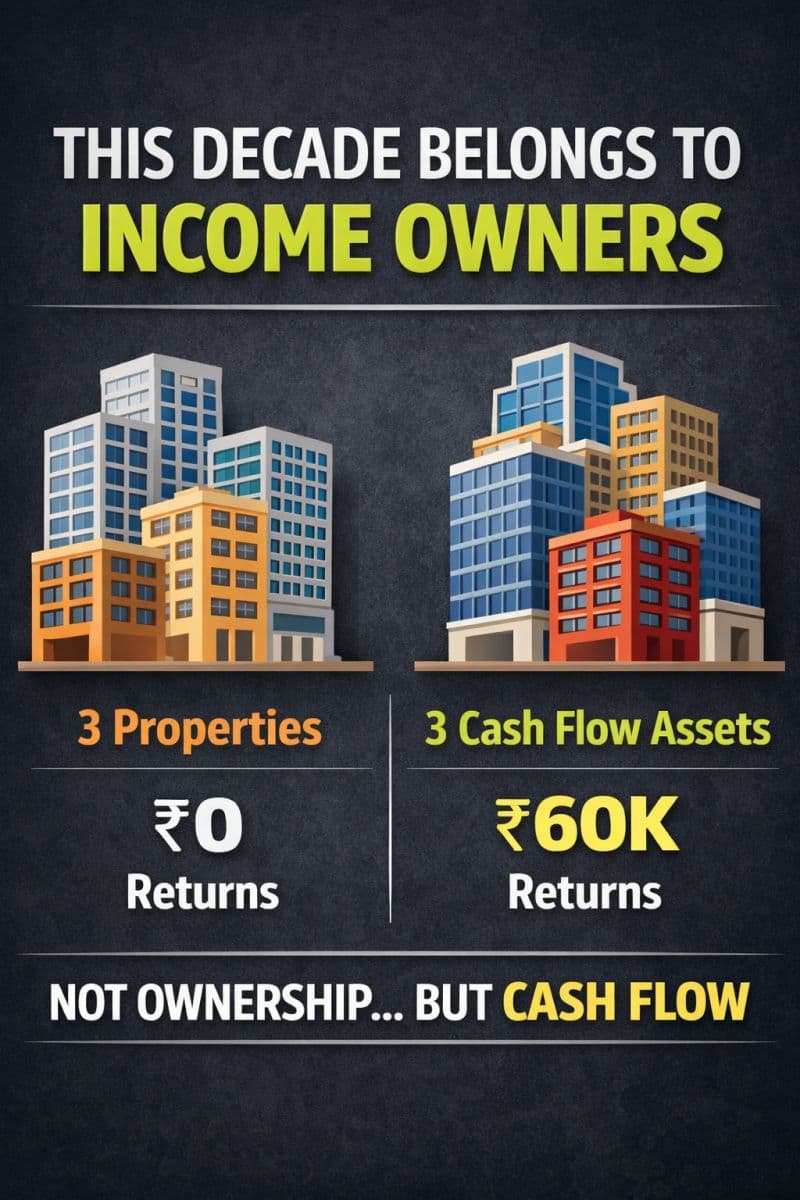
Consider the same capital deployed two ways. One ₹1.5 crore apartment at a 3% yield returns roughly ₹4.5 lakh a year, fully exposed to a single tenant and a single location. Three ₹50 lakh studios in different corridors, each let through a professional operator, can comfortably out-earn that — while insulating you from one vacancy, one bad tenant, or one soft micro-market dragging down the whole portfolio. Same outlay, very different risk profile.
A Necessary Reality Check
Studios are not magic. They deliver only when three things hold true at the same time:
- The location is strong — close to employment, transit, and daily-life amenities.
- The demand is real — backed by genuine tenant movement, not a developer's brochure projection.
- The operator is credible — with a track record of occupancy, maintenance, and timely payouts.
Get any one of those wrong and a studio is simply a smaller mistake. Get all three right and it becomes one of the most efficient assets an individual investor can own.
The Real Shift in Mindset
Earlier, real estate meant appreciation — a bet on what the asset might be worth years from now. Now it increasingly means cash flow and liquidity: what it pays you today and how easily you can move in or out. Managed, income-generating studios are becoming the smart investor's choice not because they are fashionable, but because they line up with how serious people now think about money.
Would you rather own one ₹2 crore asset that sits quietly on paper, or build a portfolio that actually pays you every single month?