Dubai's Rental Yields: What You Earn vs What You Keep
Everyone talks about Dubai's advertised 6–8% rental yields. Far fewer talk about the net yield — what's actually left after costs. Here's the honest math, and the alternative NRIs are quietly choosing.
Key Takeaways
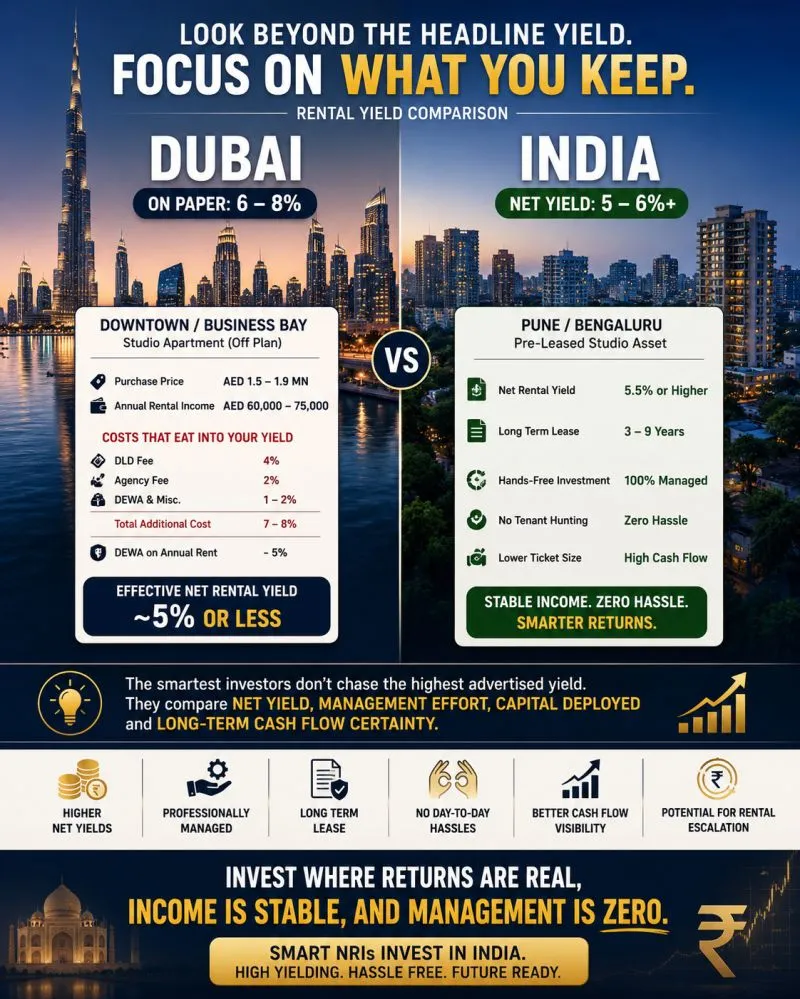
- Dubai residential is marketed at 6–8% yields, but acquisition costs (DLD 4%, agency, DEWA) add roughly 7–8% to the purchase price.
- After ownership and utility expenses, the net rental yield often settles closer to 5–6% — and sometimes lower.
- Pre-leased studio assets in established Pune and Bengaluru micro-markets are offering comparable net yields of 5.5%+.
- The smartest investors compare net yield, management effort, and cash-flow certainty — not the headline number.
Everyone talks about Dubai's rental yields. But only a few talk about the net rental yield — the number that actually lands in your pocket.
On paper, residential properties in Dubai are often marketed as offering 6–8% rental yields. It sounds attractive. But let us take a closer look.
The Headline Number
In marquee locations such as Business Bay and Downtown Dubai, even a studio apartment is currently marketed in the range of AED 1.5–1.9 million (based on listings across leading property portals). The annual rental income? Typically AED 60,000–75,000.
| Metric | Figure |
|---|---|
| Studio price (Business Bay / Downtown) | AED 1.5–1.9 million |
| Annual rental income | AED 60,000–75,000 |
| Advertised gross yield | 6–8% |
The Costs Nobody Advertises
The marketed yield is calculated on the sticker price. The real acquisition cost is higher once you factor in:
- DLD Registration Fee — 4%
- Agency Fee
- DEWA-related costs and deposits
- Miscellaneous acquisition costs
Suddenly, your actual acquisition cost is 7–8% higher than the purchase price — and every percentage point added to your cost base quietly pulls your real yield down.
Then Comes the Operational Side
While residential properties may not attract VAT on rent, landlords still need to account for various ownership and utility-related expenses. Once these are factored in, the net rental yield often settles closer to 5–6% — and, in some cases, even lower.
An Alternative Worth Considering for NRIs
This raises an interesting question: if the objective is passive rental income, are there alternatives worth considering?
In India, select pre-leased studio assets in established micro-markets of Pune and Bengaluru are offering comparable net rental yields in the range of 5.5% or higher. The difference lies in how the asset works for you:
- Lower ticket size
- Professionally managed assets
- Long-term lease structures
- No tenant hunting
- No day-to-day operational hassles
- Potential for rental escalation over time
The Real Lesson
The smartest investors do not chase the highest advertised yield. They compare the net yield, the management effort, the capital deployed, and the long-term cash-flow certainty before making a decision.
Because ultimately, it is not what the property earns. It is what you keep.